



In the world of sustainable design, few objects offer as much potential for meaningful innovation as the humble chair.
In this Q&A, Geoff Isaac, author of Rethinking Plastics in Product Design, explains why chairs were selected as the artefact through which to explore material innovation. With more than 60 examples compared in the book, the analysis reveals both the promise and the complexity of designing sustainable products that people actually want to live with.
This conversation also delves into the nuances of desirability, why sustainability alone isn't enough, and why even the greenest product is ineffective if it fails to appeal to consumers. Isaacs’ eco-audit tool incorporates factors like price, colour range, and configuration variants to assess appeal alongside environmental impact.

Central to the discussion is the Bell Chair by Konstantin Grcic for Magis, a standout example of thoughtful, circular design made from post-industrial waste. As a distributor of Magis in Australia, Living Edge is proud to support such innovation and contribute to broader conversations about responsible material use. Through stories of design experimentation and evolving consumer expectations, this Q&A serves as a call to action for all sectors of the design industry.
Why did you choose the chair as the artefact to investigate how we can rethink the use of plastics in sustainable product design?
Chairs have often been used to test new materials (especially plastics) as they become available to designers developing consumer products. To succeed chairs must be both aesthetically pleasing and strong enough to withstand years of continuous use. If a material is deemed successful when used to make a chair, it demonstrates that it is suitable for a wide range of applications across consumer goods.
After World War II, Charles and Ray Eames were able to produce a range of chairs featuring bent plywood, a material that had been transformed during the war thanks to the development of polymer adhesives. Eero Saarinen perfected his Tulip Chairs by working with a company that had developed expertise in fibreglass while working for the navy during the war. More recently there has been significant interest in new materials, recycled plastics or bioplastics (renewable plastics) that promise lower environmental impacts compared with virgin fossil plastics. In the past decade or so there have many chairs designed using these materials (I compared 60 of them for my book) so there are plenty of examples to examine and determine if any of these materials actually do deliver environmental benefits.
I was interested in your decision to include appeal as a key factor in your eco-audit tool; what role do appeal, and desirability play in the potential impact of an environmentally responsible design?
There are plenty of eco-audit tools available that attempt to evaluate the environmental impacts of products. Often referred to as the gold standard, Life Cycle Assessment (LCA) offers a highly developed methodology to guide practitioners through a detailed examination of the impacts of every component of their product. While many of these tools have their own methodological problems, they all fail to address product appeal.
We have all seen godawful ugly products made out of recycled plastic. For example, I’m thinking about multi coloured thongs designed to signal they have been made out of recyclate. While these products might well impose a lower environmental burden, thanks to the use of recycled materials, they don’t actually deliver an environmental benefit if they don’t sell. If people continue to buy thongs made from virgin fossil plastics and the ones made from recycled plastics remain unsold on shelves in shops and warehouses, they are a complete waste of resources. I see this as a critical in developing sustainable products – they must actually sell and displace the purchase of a less sustainable product to deliver a positive environmental outcome.

Having said that, appeal is of course incredibly difficult to mention. The chairs I have selected for my home almost certainly won’t appeal to everybody. While many of the reasons for this difference in taste are subjective there are, I argue, certain criteria can be objectively measured. Most obvious is price – economics tells us the lower the price of a product, the more likely it is to sell, for the simple fact more people can afford it. Colour is also very important – if a chair is available in a range of colours it is more likely to appeal to a wider audience, keen to select a colour that complements their décor. Finally, the number of variants offered will impact appeal. If a chair is available with options of a ski-base, a pedestal base, or a traditional four-legged version, it is more suitable for a range of tasks across the home and in the office, so demand is likely to increase. Obviously thinking about chairs there are a lot more factors that impact appeal that can’t be easily measured. How comfortable it is for a start. In my research I just evaluated these three simple measures (price, colours and variants) to try and bring appeal into the discussion about what constitutes a successful more sustainable product.

Chapter 5 includes an important discussion on the aesthetics of recycled and renewable plastics and its impact on desirability and demand. Do you think this new ‘sustainable aesthetic’ will become more desirable to a wider audience as the use of recycled materials is normalised in product design?
Recycled plastics and bioplastics often can’t achieve the same perfect homogenous consistency when compared with virgin fossil plastics. Variations in composition and unavoidable impurities can cause swirls or blemishes to appear on the surface of these materials. While some designers have tried to conceal these limitations, others have embraced the opportunity to experiment. This creates and opportunity to develop new aesthetic experiences.
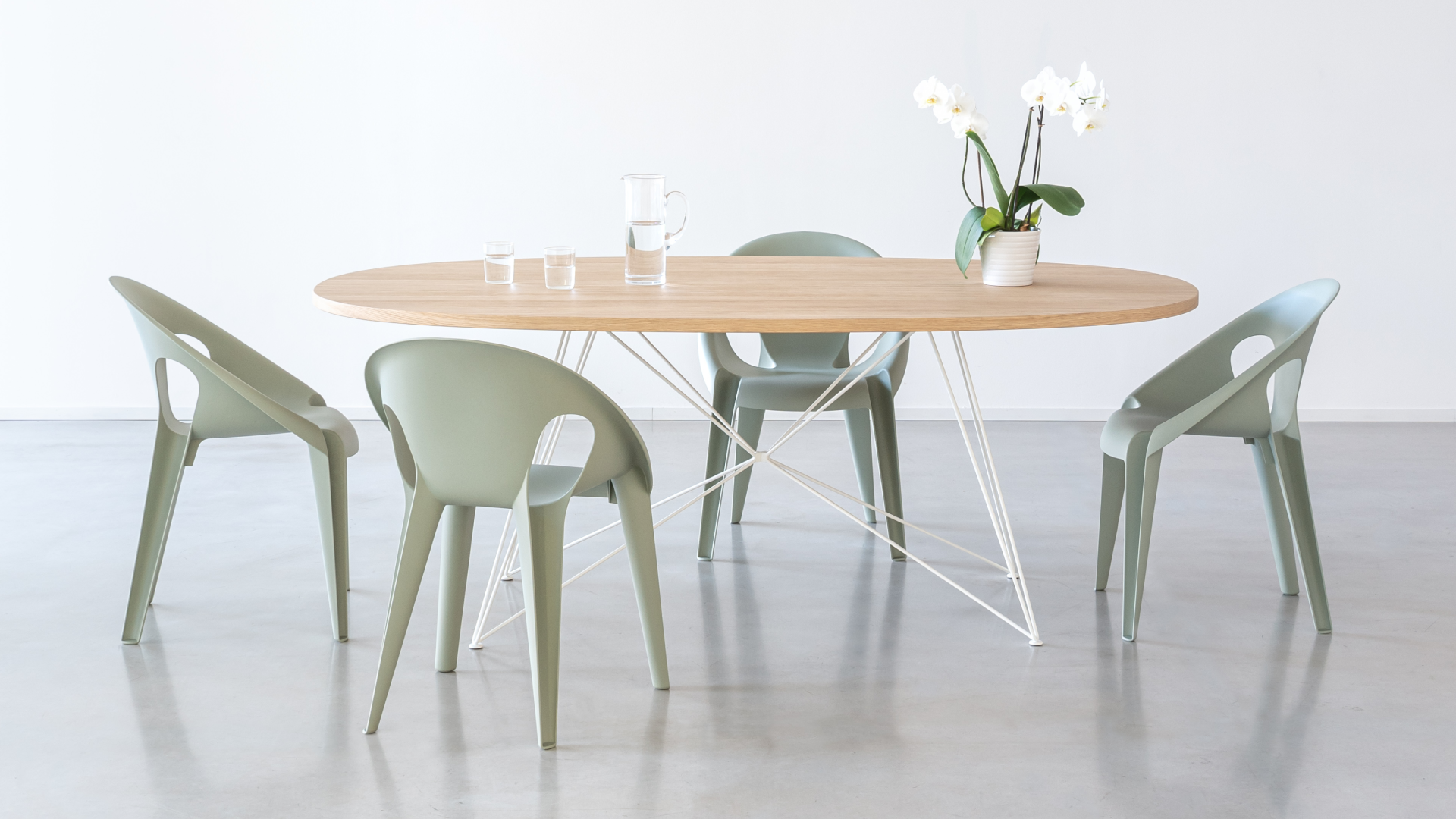
The Bell Chair is a great example here. When developing the chair, it was realised that it was not possible to completely eliminate the black speckles that appeared randomly on the surface of the chair. Instead of trying to hide this imperfection the designer (Konstantin Grcic) working with the manufacturer (Magis) decided to lean into it and introduce more black speckles, allowing a more uniform spread to be obtained. They even came up with a name for the final effect, ‘stracciatella’. Just by looking at the chair you can see it is not made from traditional plastic. This highlights a significant opportunity to develop unique products using mass production techniques, every chair is slightly different, something that can’t be achieved moulding traditional plastics.

Colours are important here as well. When working with recycled plastics it is usually not possible to produce vibrant primary colours or pure blacks and whites. Again, this challenges designers to work within the confines of the material and develop a colour palette that complements today’s interiors.
In the book, you refer to Victor Papanek’s concept of the ‘graceful aging’ of a product. This idea is close to our hearts at Living Edge and is found in our philosophy of Furniture for Life. Do you think recycled and renewable plastics lend themselves better to graceful ageing and longevity than virgin plastics?
In the Space Age (1957-69) many products celebrated plastic-as-plastic, by featuring brightly coloured glossy surfaces. Products were often promoted for their ease of use, with the promise that perfect surfaces could be indefinitely maintained, simply by wiping them with a damp cloth. By the mid-1970s, the plastic-as plastic look had gone out of fashion and one of the contributing factors that these surfaces often got easily scratched, which trapped dirt ruining the utopian dream. Recycle plastics and bioplastics often feature matte or textured surfaces and might have imperfections, as discussed above, so there is less pressure to maintain a perfect surface. I think this makes them a practical choice for furniture, especially in family homes. Scratches and knocks are absorbed into the surface, contributing to the patina as the product ages, just as they do with wooden furniture.

The primary objective for sustainably minded designers and manufacturers should be to develop products that are designed for a long and useful life. End of life environmental impacts can be delayed through good design, backed by strategies such as ensuring spare parts are available and that items can be reupholstered easily. This is the best contribution makers can achieve to improving the sustainability of their products. Renewable plastics can help achieve this desired longevity.
The results of your study provide valuable insights into the role recycled carbon-plastics can play alongside newer bioplastics. What do you think these insights mean for the future of onshore material recovery and recycling infrastructure in Australia?
Unfortunately, we are well behind the ball here! Up until 2018 we dealt with our waste plastic issue by exporting it, mainly to China. Since China (and other Asian countries) banned imports of mixed waste plastic at the start of that year we have been struggling to find solutions. Investments are being made in new recycling infrastructure but of course that takes years to deliver results. Currently, we are only recycling about 9% of the plastic we use (with a little bit more getting burnt for energy recovery). So, it is challenging for local designers and manufacturers to find reliable supplies of these materials.
Most of the recycling that does happen in Australia can more accurately be described as downcycling. The clear plastic bottles you through in your yellow bin don’t get turned into new bottles, they are downcycled to polyester, which makes it was into our wardrobes. The industry is developing new ‘advanced’ recycling techniques which promise better outcomes, but we are yet to see the benefits of these new approaches.
Living Edge is proud to represent Magis in Australia, and we were delighted to see Konstantin Grcic’s Bell Chair score highest in your study of environmentally responsible products. What is your favourite aspect of the design?
Yes, the Bell Chair was the stand out design from my comparison of 60 chairs made using recycled plastics or bioplastics, with a score of 18/20. Even though the chair launched in 2020, I still have not found a design that achieves a higher score. The secret of the success of this design stems from the close collaboration between the designer (Konstantin Grcic), the manufacturer (Magis) and the injection moulding specialist.
The most outstanding feature is how lightweight the design is. At just 2.6kg, the Bell Chair is significantly lighter than the average plastic chair (about 4kg). This of course means that less energy is consumed when heating the plastic to mould the chair, there is less to melt. But the environmental benefits do not end there, less weight means less energy is consumed during production, less fuel is required to transport the chair and even at the end of life there is less material to dispose of (or recycle).

The material used to make the chair is actually production waste collected from other products produced by the same injection moulding specialist mixed with waste from other local manufactures. This post-production waste has not been exposed to environmental degradation and is of high quality and the transport impacts of getting the material to the point of production are negligible. All these factors contribute to reducing the environmental impact of the design.
Rethinking Plastics in Product Design is a call to action for the design industry; what role can distributors like Living Edge play in the transition to the responsible use of plastics in products and furniture?
Distributors have a crucial role to play in communicating both the provenance and benefits of renewable plastics. Recycled plastics carry with them the story of their previous existence. Bioplastics, made from renewable organic resources, often have compelling backstories of how they were developed into materials suitable for use in consumer products. Virgin fossil plastics come directly from fossil resources with a history of violence and environmental destruction. The contrast of previous lives and origins of renewable plastics create interesting and engaging narratives which need to be told to differentiate these materials.
Not long ago, we rarely questioned the source of timbers used in our furniture. Today it is common for distributors to highlight that timbers used in the furniture they supply are Forest Stewardship Council (FSC) certified. Products made using timber from old-growth forests are simply not acceptable. In the coming years, I hope that only renewable plastics will be sold, and that virgin fossil plastics will be regarded with the same distain. The support of distributors in promoting the benefits of renewable plastics is vital as we transition away from virgin fossil-plastics and shape a more sustainable materials economy.
